


When we examine modern online slot games, not many mechanics produce as much anticipation as the lock and spin feature. This bonus round, frequently called hold-and-win or respin collect, freezes special symbols in place while the remaining reels spin again, building a chain of suspenseful moments that can lead to fixed jackpots or substantial cash prizes. Yet not every high-profile slot depends on this mechanic. Gates of Olympus, a title that has captivated Indian players, adopts a completely different route with its tumble system and multiplier collection. In this article we contrast lock and spin features across popular slots, detail how they work, and then analyze why Gates of Olympus deliberately avoids them in favour of a cascading, multiplier-driven design. By understanding the structural differences, you can make informed choices about which gameplay style suits your appetite for risk, pacing, and reward. We will go over the nuts and bolts of hold-and-win rounds, contrast them with scatter pays and tumbling reels, and provide a detailed breakdown of the Gates of Olympus experience, including its RTP, volatility, bet range, and maximum win potential.
Contrasting Lock and Spin Jackpots to Multiplier Accumulation
If we put a standard hold-and-win game alongside Gates of Olympus, the distinction in reward structures becomes clear. In a lock and spin slot, the bonus round often features four fixed jackpots: Mini, Minor, Major, and Grand. The Grand jackpot is usually awarded exclusively when the full grid fills with money symbols, and its value is commonly a set multiple—typically 1,000x to 2,500x the bet—or a standalone progressive amount. The rest of the jackpots are lower, and the bulk of the feature’s payout comes from the sum of visible cash values on locked symbols. This setup provides the player a clear target: fill the screen, win the Grand. Gates of Olympus does not provide any fixed jackpot tiers. Rather, it relies on the additive power of multiplier orbs and the global multiplier in free spins. The maximum win of 5,000x is no jackpot you can see on the screen; it is a ceiling that the game’s math imposes. The path to that ceiling is uncertain because it depends on the frequency and size of multiplier symbols that land during tumbles. One free spins round may finish with a modest 50x total win, while another may surge past 1,000x if several 100x or 500x orbs land and combine. This renders the experience less about methodically filling a grid and focused on riding a wave of multiplier accumulation. For players who appreciate the clarity of a jackpot ladder, lock and spin provides a clearer goal. For those who prefer the thrill of a potentially unlimited climb within a cap, Gates of Olympus offers a different emotional arc.
How to Play Gates of Olympus and What to Look Out For
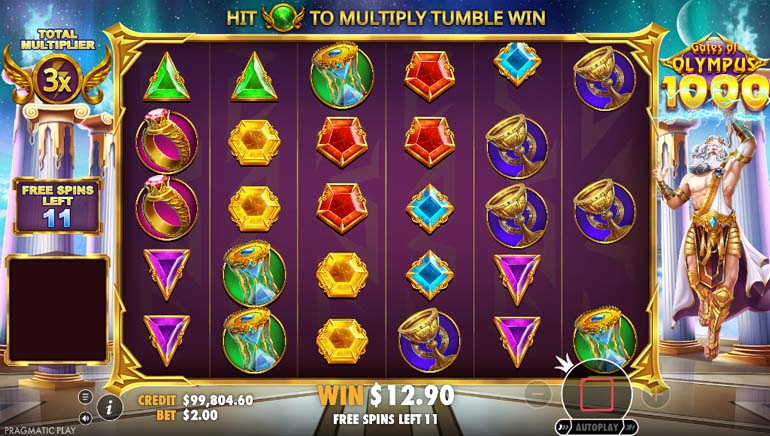
Starting Gates of Olympus is easy even for newcomers. After loading the game, you pick your bet amount using the plus and minus buttons, then click the spin button. Wins are given when eight or more matching symbols show up anywhere on the 6×5 grid. The paytable, accessible via the information icon, shows the payout for each symbol based on the number of matches, going from the low-paying gemstones to the high-paying goblet, ring, hourglass, and crown. The most valuable standard symbol is the crown, which pays 50x the bet for 12 or more on screen. There is no wild symbol in the conventional sense; instead, the scatter symbol starts free spins, and the multiplier orb is the special feature symbol. A handy option is the ante bet, which boosts the stake by 25% and doubles the chance of triggering free spins naturally by adding more scatter symbols to the reels. For those who desire immediate access to the bonus, a buy feature is offered in jurisdictions where it is allowed, enabling you to acquire entry into the free spins round for 100x the base bet. We suggest testing the game in demo mode first to grasp how tumbles chain together and how multiplier orbs function before putting real money. Pay close attention to the global multiplier meter during free spins, as it is the single most crucial indicator of the round’s potential.
Hold-and-Win as the Dominant Lock and Spin Variant
While lock and spin is a wide term, the most widespread implementation is the hold-and-win format popularized by providers like Pragmatic Play, iSoftBet, and Playson. In a usual hold-and-win game, the base game includes money symbols that carry random cash values or jackpot labels. When at least five or six of these symbols appear simultaneously, the hold-and-win round begins. All triggering symbols are kept fixed, and the player initiates with three respins. Each time a new money symbol shows up, it holds, and the respin count goes back to three. If all 15 or 20 positions on the grid become filled with money symbols, the Grand jackpot is given. Even without filling the entire screen, the accumulated values can provide wins far exceeding the base game’s line hits. What sets hold-and-win apart from older lock and spin variants is the frequent inclusion of jackpot tiers that are independent of the bet size, giving low-stake players a shot at life-changing sums. However, the hit frequency of the feature is usually low, often needing hundreds of spins to trigger naturally, which indicates bankroll management becomes vital. For Indian players who like a bonus that accumulates slowly and visibly, hold-and-win provides a distinct, measurable progression that is absent from many other bonus types.
Multiplier Symbols and the Complimentary Spins Feature
The heart of Gates of Olympus revolves around its multiplier signs and the free spins phase. At any moment during the base game or free spins, a winged multiplier orb can land on the reels. These orbs hold random values spanning from 2x up to a colossal 500x. When one or more multiplier symbols occur with a winning tumble sequence, their values are added together and used for the total win of that tumble cascade. This indicates a single spin can gather multiple multipliers if several orbs land during successive tumbles, leading to exponentially boosted payouts. The free spins feature initiates when four or more scatter symbols—depicted as Zeus himself—appear anywhere on the grid. You get 15 free spins initially, and getting three additional scatters during the feature grants five extra spins. During free spins, any multiplier symbol that appears is not only used for the current win but also incorporated into a global progressive multiplier that expands throughout the entire round. Every subsequent win in the free spins is boosted by this accumulating total, which can climb to staggering levels if you hit multiple high-value orbs early. This mechanic substitutes for the lock and spin jackpot chase with a cumulative multiplier race, where the ceiling is not a fixed Grand prize but a dynamic multiplier that can in theory push the 5,000x max win cap.

RTP, Kolísavost, and the Systém scatter výher
Gates of Olympus works with a default return to player (RTP) of 96.5%, though operators can offer lower configurations, so it is always advisable to check the game information panel before spinning. The volatility is classified as high, which indicates wins are spread unevenly: long dry spells can arise, but when the game delivers, the payouts can be significant. The scatter pays mechanic replaces traditional paylines completely. You need a minimum of eight identical symbols anywhere on the 6×5 grid to obtain a win, and the payout increases with the number of matching symbols, up to a maximum of 12 or more. After any winning combination, the tumble feature activates: winning symbols are removed, new symbols drop down, and the grid is checked again. This process repeats as long as new winning clusters emerge, effectively offering you multiple chances to win from a single spin. The lack of paylines means that symbol positions are less important than sheer quantity, which modifies the strategic feel. In a lock and spin game, you often monitor specific reel positions for jackpot symbols; here, you simply look for clusters to build. The high volatility paired with scatter pays causes the base game competent of producing mid-sized wins through tumbles, but the real weight of the math model rests inside the free spins feature.
What Specifically Is a Lock and Spin Feature
A lock and spin feature represents a bonus round where particular symbols get sticky on the reels, and the user gets a predetermined number of respins in which only unique symbols or blanks appear. Typically, the feature activates when a minimum number of designated symbols—often coin symbols or orbs—land anywhere on the reels. These triggering symbols stay locked, and the respin counter returns to the starting value each time a fresh special symbol hits. The goal is to cover as many positions as feasible before exhausting respins. At the finish of the round, the values on all sticky symbols are added together and paid out. Many variants also feature fixed jackpot prizes attached to specific symbols, such as Mini, Minor, Major, and Grand tiers, which are granted if the relevant symbol appears during the feature. This system builds a distinct visual advancement: the grid progressively becomes filled with locked prizes, and every additional symbol that stays revives the anticipation of a complete screen. The excitement lies in the shrinking respin counter, rendering each empty spin feel more significant. For Indian players who enjoy a organized bonus with noticeable milestones, lock and spin delivers a transparent path to a payout that is simple to understand even lacking deep slot knowledge.
Wager Range and Top Prize Potential
Gates of Olympus supports a wide range of playing styles with a bet spectrum that usually begins at 0.20 and goes up to 100 per spin, though the exact limits may differ a bit depending on the casino platform. The game’s maximum win is limited to 5,000 times the total bet, meaning a single spin or free spins sequence can generate up to 500,000 in currency if you are playing at the highest stake. This cap is a strict boundary; even if the progressive multiplier in free spins would mathematically exceed 5,000x, the round halts once that threshold is attained. For Indian players who often think in terms of rupees, a 0.20 bet corresponds to roughly 17 INR, while the maximum bet reaches 8,300 INR, creating the potential top prize around 4.15 crore INR at maximum stake. The bet range is broad enough to fit casual players testing the waters and high rollers chasing the upper limit. In contrast, many lock and spin slots link their maximum payout to the Grand jackpot, which is commonly a fixed multiple of the bet or a static amount. The key difference is that in Gates of Olympus, the 5,000x is constantly relative to your stake, so the reward scales linearly with your bet size, whereas a hold-and-win Grand jackpot might be a fixed sum that does not rise when you raise your wager.
In what way Lock and Spin Stands Apart from Tumble and Cascade Mechanics
Lock and spin features function on a completely separate idea than tumble or cascade mechanics. In a lock and spin round, symbols remain static once they show up, and the gameplay centers on the respin counter and the progressive filling of the grid. There is no removal of winning combinations and no replacement with new symbols descending from above. By contrast, a tumble or cascade system clears all winning symbols after a payout, allows new symbols to fall into the empty spaces, and checks the grid again for additional wins. This chain reaction can go on indefinitely as long as new winning combinations arise. The psychological rhythm is therefore reversed: lock and spin builds tension through scarcity of new locks and the countdown, while tumbling reels produce a rapid-fire sequence of wins that can appear more volatile and unpredictable. Gates of Olympus utilizes a tumble mechanic, meaning that after every winning cluster, the contributing symbols are removed and fresh symbols drop down, conceivably creating consecutive wins from a single paid spin. This variation is crucial because it affects how often you encounter returns and how the game’s variance manifests itself. Lock and spin features concentrate value in a infrequent but organized bonus, whereas tumble systems distribute volatility across the base game and free spins in a more fluid manner.
Gates of Olympus: A Distinct Design Philosophy
Gates of Olympus player reviews IN, developed by Pragmatic Play, consciously departs from the lock and spin blueprint. In place of collecting symbols on a fixed grid, the game ushers players into a mythologic Greek realm where Zeus rules over a 6-reel, 5-row layout that employs a scatter pays engine. There are zero traditional paylines; a win takes place any time at least eight matching symbols land on any spot on the screen. This all-ways approach already marks a departure from the organized, position-based thinking of hold-and-win games. The visual theme is laden with golden thrones, goblets, rings, and gemstones against a cloudy Mount Olympus backdrop, alongside a dramatic orchestral score. The absence of a lock and spin round is by no means an oversight but a deliberate choice to highlight multiplier accumulation and cascading wins. By taking away the rigid respin counter, the game generates a more open-ended bonus experience where a single free spin can amplify into thousands of times the stake if the right multiplier symbols appear. For Indian players used to high-volatility entertainment, this design provides a distinct kind of thrill—one rooted in sudden, explosive potential rather than the methodical filling of a grid.
Which Feature Matches Different Playing Styles
Choosing between a lock and spin slot and a game like Gates of Olympus finally hinges on what you value in a bonus round. If you prefer a structured, expected progression where you can see precisely how many positions remain and what each locked symbol is worth, hold-and-win mechanics are likely more satisfying. The fixed jackpot tiers offer you a clear hierarchy of goals, and the respin counter offers a specific endpoint. This suits players who like methodical tension and want to know that a full screen guarantees the top prize. On the other hand, if you are attracted to volatility that can spike without warning and enjoy watching multipliers stack during a cascade, Gates of Olympus offers a more chaotic but possibly more profitable ride. The absence of a lock and spin feature means you never experience the frustration of a respin counter hitting zero with only a few positions filled; instead, every tumble is a renewed opportunity. Indian players who have grown fond of fast-paced, high-ceiling games often gravitate toward the multiplier accumulation model because it can turn a single free spin into a life-changing win without the need to fill a grid. Both approaches carry merit, and grasping their differences enables you to handle your bankroll and expectations more effectively.
Ultimately, lock and spin mechanics and the multiplier-driven tumble system of Gates of Olympus reflect two different philosophies in slot design, each with its own rhythm, risk profile, and reward structure. The hold-and-win format provides you with a clear visual target and a set jackpot ladder, making it simpler to follow your progress and anticipate the outcome. Gates of Olympus replaces that rigidity with fluid cascades and a progressive multiplier that can increase dramatically in a few of spins. Neither is fundamentally superior; the better choice is the one that matches your temperament and session goals. If you find yourself frustrated by respin counters that run out too soon, the endless tumble chains and multiplier orbs of Gates of Olympus may feel liberating. If you like the certainty of knowing that filling the screen secures a Grand prize, a lock and spin title will serve you well. We encourage you to test both styles in free play, watch how the math models affect your balance over a few hundred spins, and then choose which mechanic keeps you engaged and entertained. The Indian online slot landscape presents plenty of quality options in both categories, so you can always change between them depending on your mood and strategy.